{STORYTITLE}
Name: Aïlen B
Country of residence: Switzerland
Writing language: French
Read story below!

Story language
If the sky was blue today
Si le ciel était bleu aujourd'hui
Je m’appelle Aïlen Briatico. Aïlen est un prénom mapuche, originaire d’Amérique du Sud. Briatico est à la fois un nom de famille italien et une ville de Calabre, dans le sud de l’Italie. J’ai donc décidé d’ajouter le nom de famille de ma mère : Golberg — qui, probablement, a perdu son D dans l’océan Atlantique.
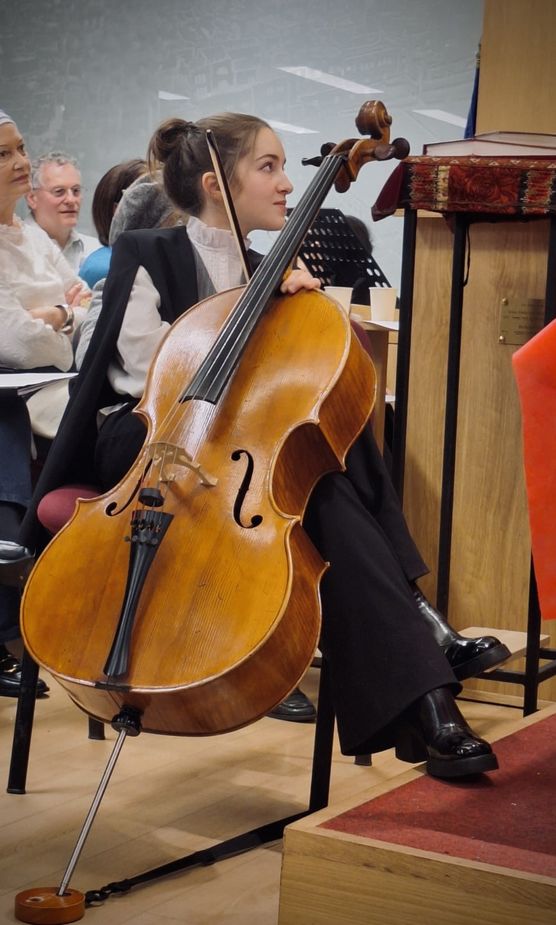
Je suis violoncelliste, étudiante à Genève. Lorsque l’on me présente avant d’entrer sur scène, je suis donc Aïlen Briatico-Golberg. Ainsi, j’ai au moins l’impression que « tout » est présent sur scène.
Je dois souvent écrire des autobiographies dans le cadre de ma carrière. Souvent centrées sur ma pratique du violoncelle, elles s’orientent, selon les destinataires, sur mon parcours académique, les concours, les concerts, les festivals ou encore les projets « annexes ». Ici, elle s’orientera donc sur ma judéité : vous aurez donc une partie de moi — mais cette fois, au-delà d’une simple accumulation de faits et de noms communs. Si l’on me laisse parler sans format, je vais m’attarder sur ce qui me plaît. Et j’ose espérer que, parce que je parle de moi, je pourrai aussi mettre les autres sur la bima.
La plupart des moments importants de l’année s’inscrivent dans la lignée de mon héritage juif.
C’est le jour où je ne peux pas rentrer en France pour le seder de Roch Hachana en famille. Mais aussi celui où je m’assure d’assister à l’office de Kippour de Yaël et Olivier.
C’est celui où je verse une larme pour les bnei mitzvah de ceux qui ont grandi avec moi, et ceux que j’ai vus grandir : Yoni, Meïtal, Ilan, Zoëlle.
Et l’autre jour encore, où je ne savais plus à qui parler, et j’ai trouvé, grâce à Elias, des jeunes avec qui voyager et discuter, au sein de Darkei Noam.
C’est aussi mes goûts et mes couleurs. Mon monde, où Éric et Michele sont mes chanteurs préférés, où la soupe de kneidelech est la meilleure chose pendant une semaine, et où le bleu et blanc se baladent toujours quelque part dans ma chambre.
Et c’est un monde auquel les gens s’ouvrent — ou non. Alors ils restent au pied de la porte.
Mais c’est une partie de moi que l’on ne peut pas ignorer.
Ce n’est pas un monde que tout le monde connaît : c’est un monde qu’il faut questionner.
Par chance, le questionnement est une part inhérente du judaïsme.
Lorsque j’ai découvert la théorie de l’évolution, alors que je chantais le kaddish tous les vendredis, mon désarroi m’a menée au bureau de mon rabbin, plutôt qu’à celui de mon père, le physicien.
Assise dans son bureau, avec ma mère — directrice du Talmud Torah —, sa réponse, rapportée plus tard à mon père, a convaincu la professeure, l’enfant, et l’athée.
J’ai donc toujours été ouverte aux questions, mais il ne faut jamais attendre une réponse définitive de ma part. Malgré des prises de parole dont les mots sont disséqués au peigne fin, mes paragraphes finissent le plus souvent par : « enfin, je crois ». Des réponses datées, car liées à l’expérience, à l’échange, au vécu. Caducs ou réévalués d’une année à l’autre, c’est finalement ce que m’offrent les rites : une opportunité, dans la répétition, de revoir mes pensées, de faire évoluer mon judaïsme.
Dernièrement, j’ai beaucoup parlé d’empathie avec des étudiants, en France, en Allemagne et en Suisse. J’ai parfois eu l’impression que mes pairs prenaient mes sentiments, mes inquiétudes, et les lâchaient aussitôt. Je ne comprenais pas pourquoi les peines des autres étaient valides, et les miennes n’étaient même pas un sujet. Alors la colère de ma communauté, je la comprends.
Mais moi, j’ai revendiqué toute mon adolescence — du jour où j’ai lu ma drasha, jusqu’à la marche pour Gisèle Halimi. Et j’ai récolté plus de rogne et d’incompréhension que de reconnaissance, face à l’indifférence. Toujours les mêmes aux marches : des Juifs, et des politiciens intéressés.
Lorsque j’ai eu l’impression de ne pouvoir parler qu’aux miens, parce que le reste du monde était en sourdine, je me suis souvenue que c’était le contraire de tout ce que je prônais, et de tous les discours que mon rabbin, Rivon, partageait sur l’ouverture aux autres. Mais je n’avais pas envie d’être en colère, ni de devoir débattre. Alors je procède sincèrement à quelque chose dont je n’ai pas le nom : une parole mobile, qui appelle à l’empathie des autres sans jamais demander un avis.
Je ne veux pas entendre parler d’opinion, de prise de position, mais simplement d’une profonde espérance pour tous, ou d’une démarche d’union et d’aide, qui serve à la paix et à l’entente.
On évoque souvent la fierté d’une appartenance — ethnique, religieuse, politique…
Ayant peu d’avis sur le sujet, et trop d’appartenances pour être fière de tout, je préfère me dire qu’aujourd’hui, je suis fière des liens. Des liens qui s’ouvrent d’une façon si particulière grâce à cette identité. Je suis fière lorsqu’Éléonore est venue pour la première fois voir un office à la synagogue.
Lorsque j’apprends à Juliette à dire « שלום, הכול בסדר ? » pour surprendre un collègue.
Lorsque mon copain se met dans un coin pour écouter le seder de Pessa’h par Zoom, par curiosité.
Et lorsque j’intègre la mélodie de mon psaume préféré dans une pièce que j’ai écrite, et que tous la trouvent aussi touchante que moi.
C’est lorsque mes traditions et mon savoir sont au service du partage que je suis fière.
J’ai souvent dit que la musique était la raison pour laquelle je me réveillais le matin.
Mais ce sont mes traditions qui rythment ma vie.
[This story was originally written in French and was translated to English with a translation tool to make it accessible to more readers. Cette histoire a été écrite à l'origine en français et a été traduite en anglais à l'aide d'un outil de traduction automatique afin de la rendre accessible à un plus grand nombre de lecteurs.]
My name is Aïlen Briatico. Aïlen is a Mapuche first name, originating from South America. Briatico is both an Italian family name and a town in Calabria, in southern Italy. So I decided to add my mother’s family name: Golberg — which probably lost its D in the Atlantic Ocean.
I am a cellist, a student in Geneva. When I am introduced before stepping on stage, I am therefore Aïlen Briatico-Golberg. That way, I at least have the impression that “everything” is present on stage.
I often have to write autobiographies as part of my career. Often centered on my cello practice, they focus, depending on the recipients, on my academic path, competitions, concerts, festivals, or “side” projects. Here, it will therefore focus on my Jewishness: you will thus have a part of me — but this time, beyond a simple accumulation of facts and common nouns. If I am allowed to speak without a format, I will linger on what I enjoy. And I dare hope that, because I am speaking about myself, I will also be able to bring others onto the bima.
Most of the important moments of the year follow the line of my Jewish heritage.
It is the day when I cannot go back to France for the family Rosh Hashanah seder. But also the one when I make sure to attend Yaël and Olivier’s Yom Kippur service.
It is the one where I shed a tear for the bnei mitzvah of those who grew up with me, and those I saw grow up: Yoni, Meïtal, Ilan, Zoëlle.
And also the other day, when I no longer knew whom to talk to, and thanks to Elias, I found young people with whom to travel and discuss, within Darkei Noam.
It is also my tastes and my colors. My world, where Éric and Michele are my favorite singers, where kneidelech soup is the best thing for a week, and where blue and white always wander somewhere in my room.
And it is a world that people open themselves to — or not. And so they remain at the doorstep.
But it is a part of me that cannot be ignored.
It is not a world that everyone knows: it is a world that must be questioned.
Luckily, questioning is an inherent part of Judaism.
When I discovered the theory of evolution, while I was singing the kaddish every Friday, my dismay led me to my rabbi’s office rather than to my father’s, the physicist.
Sitting in his office with my mother — director of the Talmud Torah — his answer, later reported to my father, convinced the teacher, the child, and the atheist.
So I have always been open to questions, but one must never expect a definitive answer from me. Despite speeches whose words are dissected with a fine-tooth comb, my paragraphs most often end with: “well, I think.” Dated answers, because they are linked to experience, to exchange, to what has been lived. Obsolete or re-evaluated from one year to the next, this is ultimately what rituals offer me: an opportunity, through repetition, to review my thoughts, to make my Judaism evolve.
Recently, I have spoken a lot about empathy with students in France, Germany, and Switzerland. I sometimes had the impression that my peers took my feelings, my worries, and dropped them immediately. I did not understand why others’ sorrows were valid, while mine were not even a subject. So I understand the anger of my community.
But for my part, I asserted myself throughout my adolescence — from the day I read my drasha, up to the march for Gisèle Halimi. And I received more resentment and incomprehension than recognition, in the face of indifference. Always the same people at the marches: Jews, and self-interested politicians.
When I felt that I could speak only to my own, because the rest of the world was muted, I remembered that this was the opposite of everything I advocated, and of all the talks my rabbi, Rivon, shared about openness to others. But I did not want to be angry, nor to have to debate. So I sincerely engage in something for which I have no name: a mobile speech, which calls for others’ empathy without ever asking for an opinion.
I sometimes had the impression that my peers took my feelings, my worries, and dropped them immediately. I did not understand why others’ sorrows were valid, while mine were not even a subject. So I understand the anger of my community.
I do not want to hear talk of opinion or position-taking, but simply of a profound hope for everyone, or of an approach of unity and assistance that serves peace and understanding.
People often mention the pride of belonging — ethnic, religious, political…
Having few opinions on the subject, and too many identities to be proud of everything, I prefer to say that today, I am proud of connections. Connections that open themselves in such a particular way thanks to this identity. I am proud when Éléonore came for the first time to see a service at the synagogue.
When I teach Juliette to say “?שלום, הכול בסדר” to surprise a colleague.
When my boyfriend sits in a corner to listen to the Passover seder on Zoom, out of curiosity.
And when I integrate the melody of my favorite psalm into a piece I wrote, and everyone finds it as moving as I do.
It is when my traditions and my knowledge are in the service of sharing that I am proud.
I have often said that music was the reason I woke up in the morning.
But it is my traditions that give rhythm to my life.
It is when my traditions and my knowledge are in the service of sharing that I am proud.
I have often said that music was the reason I woke up in the morning.
But it is my traditions that give rhythm to my life.
Scroll through our most
recent collection below
Your story could be next!

Kaleidoscope is a project of the Rothschild Foundation Hanadiv Europe
- Design by Creative Interpartners
- Website by Beachshore