
{STORYTITLE}
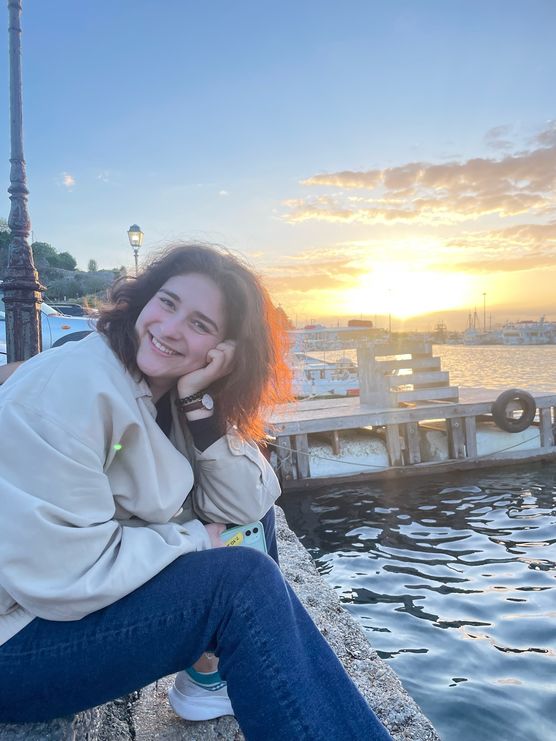
Name: Natacha H
Country of residence: France
Writing language: French
Read story below!

Story language
Growing up in Strasbourg
Grandir à Strasbourg en tant que femme juive
Quand on m’a contacté pour raconter mon histoire, ma première pensée a été : mon histoire existe à travers ma famille et mes proches. Pour pouvoir la raconter, je dois d’abord vous parler un peu de l’histoire de ma famille.
Ma mère est née à Lupeni, en Roumanie, et a grandi sous le communisme de Ceaușescu jusqu’en 1991, année où elle est arrivée en France.
Son éducation juive, invisible de l’extérieur mais présente, lui a été transmise par ses parents et grands-parents. Les valeurs du judaïsme tel que le respect de l’autre ou le tikkun olam qu’elle nous a transmis à son tour. Elle a eu en arrivant à Strasbourg un engagement militant au sein de la communauté juive qu’elle m’a également transmis.
Mon père est né à Strasbourg dans une famille alsaco-marocaine issue d’un mariage mixte. Il a grandi dans un environnement catholique et juif, où il a pu suivre ces deux traditions.
À l’âge de 13 ans, lors de sa bar-mitsvah, il a choisi de suivre un chemin judaïque plus poussé.
Après leur rencontre et ma naissance, mes parents ont décidé de m'inscrire dans une école juive pour la maternelle. J'y suis restée une année. Ensuite, j'ai suivi un parcours international dans une école publique en Alsace. L’Alsace étant une terre concordataire, la possibilité de suivre un cours de religion juive était offerte, et de l’école primaire au lycée, j’ai bénéficié d’une heure d’éducation religieuse par semaine.
En parallèle de l’école, je suivais les cours de talmud torah les mercredis matins, où j’ai appris à lire et écrire en hébreu ainsi que les fêtes traditionnelles. À la maison, j’apprenais la culture, les traditions, et la joie des fêtes en famille et avec des amis.
Mes parents ne pensaient pas que l’antisémitisme pourrait m’atteindre à Strasbourg, ville européenne multiculturelle. Pourtant, dès la sixième, les attaques antisémites m’ont touchée.
En cours d’allemand, j’avais décidé de présenter le Journal d’Anne Frank. Dès ce jour, j’ai été considérée comme la « juive » par la plupart de mes camarades, et j’ai été témoin de remarques telles que « sale juive » et « t’en as pas marre de parler de la Shoah, Natacha ? ».
Entourée par quatre bons amis, j’ai toujours réussi à parler d’entente des religions et à essayer de faire découvrir une partie de mon identité en répondant aux questions pour démystifier le judaïsme.
C’est à ce moment que je me suis rapprochée de Simone, survivante d’Auschwitz. Simone a joué un rôle clé dans ma vie personnelle et dans le début de mon militantisme, en particulier pour la mémoire de la Shoah.
Grâce à elle, j’ai pu organiser des témoignages et des discussions pour sensibiliser collégiens, lycéens et étudiants à l’importance du devoir de mémoire.
Mon militantisme au sein de l’UEJF (Union des Étudiants Juifs de France) a réellement débuté en juin 2022, lorsque je suis devenue présidente de la section locale à Strasbourg. Dès lors, j’ai souhaité organiser des événements réunissant tous les étudiants désireux de découvrir ou d’apprendre sur les traditions juives.
En organisant des shabbatonim, des séminaires et des fêtes avec de la médiation interculturelle, j’ai moi-même appris de nouvelles traditions à chaque événement.
L’identité juive fait partie intégrante de mon quotidien depuis le 7 octobre 2023. Depuis ce jour indescriptible, mon quotidien est marqué par les problèmes antisémites (sous couvert d ‘antisionisme), le soutien à Israël dans les universités, ainsi que la sensibilisation à la lutte pour les otages auprès des élus locaux et nationaux.
Cet événement, que j’ai vécu comme un coup de couteau, m’a permis de réaliser et de vivre encore plus intensément la phrase « כל ישראל ערבים זה בזה » qui signifie « tout Israël est responsable l’un de l’autre ».
Cette phrase, qui est le slogan du Congrès Juif Mondial (WJC), m’a rappelé qu’il existe autant d’identités, de traditions et de croyances que de Juifs. Grâce au Lauder Fellowship, j'ai eu l’opportunité de faire partie de ce programme réunissant des étudiants du monde entier.
Cet engagement m’a permis, à travers différents médias, de faire entendre ma voix et celle des étudiants juifs. Chaque jour, je prends conscience de l’opportunité et de la responsabilité que cela représente.
La possibilité d’exprimer cette voix est un privilège que mes parents et grands-parents n’ont pas eu, et pour cela, je suis honorée de pouvoir le faire, pour eux.
C’est sur cette beauté et cette unité de la communauté juive que je souhaite conclure cet article. Dans un monde où l’antisémitisme est à son apogée depuis la Seconde Guerre mondiale, ce qui me fait tenir et continuer mon combat reste le soutien, l’unité et la résilience du peuple juif.
Grâce à WJC, j’ai eu l’occasion de créer un podcast sur les Juifs de Roumanie intitulé « Tree of Life: My Romanian Jewish Roots », accessible sur plusieurs plateformes.
Growing up in Strasbourg
When I was approached to tell my story, my first thought was: my story exists through my family and my loved ones. In order to tell it, I must first tell you a little about my family history.
My mother was born in Lupeni, Romania, and grew up under Ceaușescu's communism until 1991, when she arrived in France.
Her Jewish upbringing, invisible from the outside but present, was passed on to her by her parents and grandparents. The values of Judaism, such as respect for others and tikkun olam, she in turn passed on to us. When she arrived in Strasbourg, she became an active member of the Jewish community, which she also passed on to me.
My father was born in Strasbourg into an Alsatian-Moroccan family from a mixed marriage. He grew up in a Catholic and Jewish environment, where he was able to follow both traditions.
At the age of 13, when he had his bar mitzvah, he chose to follow a more advanced Jewish path.
After they met and I was born, my parents decided to enrol me in a Jewish school for nursery school. I stayed there for a year. After that, I followed an international curriculum at a state school in Alsace. As Alsace is a Concordat state, the possibility of taking a course in the Jewish religion was offered, and from primary school to lycée, I benefited from one hour of religious education a week.
Alongside school, I attended Talmud Torah classes on Wednesday mornings, where I learned to read and write in Hebrew, as well as the traditional festivals. At home, I learned about culture, traditions and the joy of celebrating with family and friends.
My parents didn't think that anti-Semitism could affect me in Strasbourg, a multicultural European city. However, anti-Semitic attacks have affected me since the I entered secondary school.
In German lessons, I decided to present the Diary of Anne Frank. From that day on, I was considered the ‘Jew’ by most of my classmates, and I witnessed remarks such as ‘you dirty Jew’ and ‘aren't you fed up talking about the Shoah, Natacha?’
Surrounded by four good friends, I always managed to talk about religious diversity and try to reveal part of my identity by answering questions to demystify Judaism.
It was at this point that I became close to Simone, an Auschwitz survivor. Simone played a key role in my personal life and in the beginning of my activism, particularly for the memory of the Shoah.
Thanks to her, I was able to organise testimonies and discussions to raise awareness among secondary school pupils and students of the importance of the duty to remember.
My involvement with the UEJF (Union des Étudiants Juifs de France) really began in June 2022, when I became president of the local section in Strasbourg. From then on, I wanted to organise events bringing together all the students who wanted to discover or learn about Jewish traditions.
By organising shabbatonim, seminars and parties with intercultural mediation, I myself learnt new traditions at each event.
Jewish identity has been an integral part of my daily life since 7 October 2023. Since that indescribable day, my daily life has been marked by anti-Semitic problems (under the guise of anti-Zionism), support for Israel in universities, and raising awareness of the fight for hostages among local and national elected representatives.
This event, which I experienced as a stab wound, made me realise and live even more intensely the phrase ‘כל ישראל ערבים זה בזה’ which means ‘all Israel is responsible for each other’.
This phrase, which is the slogan of the World Jewish Congress (WJC), reminded me that there are as many identities, traditions and beliefs as there are Jews. Thanks to the Lauder Fellowship, I had the opportunity to be part of this programme, which brings together students from all over the world.
This involvement has enabled me, through various media, to make my voice and that of Jewish students heard. Every day, I become aware of the opportunity and the responsibility that this represents.
The possibility of expressing this voice is a privilege that my parents and grandparents did not have, and for that I am honoured to be able to do it for them.
It is on this beauty and unity of the Jewish community that I wish to conclude this article. In a world where anti-Semitism has been at its height since the Second World War, what keeps me going and keeps me fighting is the support, unity and resilience of the Jewish people.
Thanks to WJC, I had the opportunity to create a podcast about the Jews of Romania entitled ‘Tree of Life: My Romanian Jewish Roots’, which is available on several platforms.
Scroll through our most
recent collection below
Your story could be next!

Kaleidoscope is a project of the Rothschild Foundation Hanadiv Europe
- Design by Creative Interpartners
- Website by Beachshore